

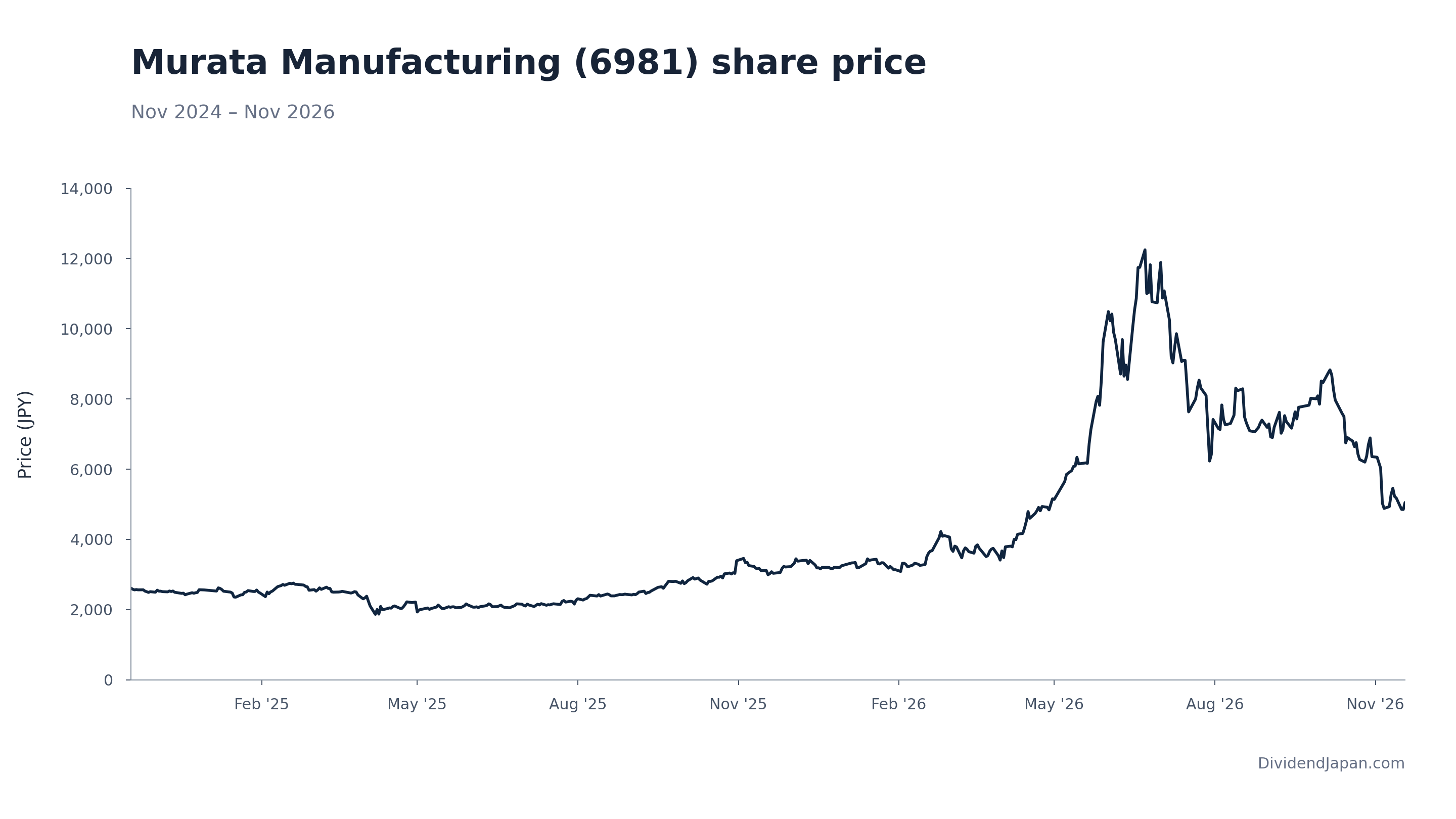
Murata Manufacturing (TSE:6981) is one of Japan’s largest electronics component manufacturers, with a market capitalization of approximately $63.6 billion. The company has extensive exposure to semiconductors, AI data centers, automotive electronics and increasingly humanoid robotics. Despite a sharp share-price correction from recent levels, Murata remains up more than 60% in 2026, while its latest financial forecasts point to substantial earnings growth.
At approximately ¥5,050 on November 18, the stock trades at an estimated 24 times earnings for the fiscal year ending March 2027. Analysts expect significantly higher profits in the following years, potentially reducing the forward P/E to 16 for FY2028 and 12 for FY2029. Meanwhile, Murata has increased its dividend for more than ten consecutive years and recently announced plans to invest approximately ¥1 trillion in additional production capacity.
Key points
Share price: ¥5,050 on November 18, 2026, following a significant correction, although the stock was still up 63.2% year-to-date on November 13.
FY2027 forecast: Revenue +23.4% to ¥2.26 trillion and operating profit +84.5% to ¥520 billion.
AI and robotics: Murata supplies electronic components for AI servers, automotive electronics, industrial automation and humanoid robots.
Dividend growth: More than ten consecutive annual increases, with five-year average growth of 11.2% and a current yield of approximately 1.4%.
Balance sheet: Approximately ¥600.6 billion in cash and cash equivalents, with very limited financial borrowings.
Valuation: Forward P/E of approximately 24 for FY2027, potentially falling to 16 and 12 for FY2028 and FY2029 based on longer-term earnings estimates.
Analyst consensus: 5 Strong Buy, 13 Buy, 1 Hold and no Sell recommendations.
Murata Manufacturing: a Japanese electronics giant
Murata Manufacturing was established in Kyoto in October 1944 by Akira Murata, initially producing ceramic capacitors used in radios. The business was formally incorporated in December 1950 and subsequently expanded into a global supplier of advanced electronic components.
Today, Murata employs approximately 74,300 people and operates a worldwide manufacturing and distribution network.
The company specializes in passive electronic components, particularly multilayer ceramic capacitors (MLCCs), together with inductors, filters, sensors, connectivity modules, timing devices, batteries and power-management solutions.
Although Murata is frequently associated with Japan’s semiconductor industry, it is primarily an electronic components manufacturer rather than a producer of semiconductor chips.
Its products are essential to the operation of devices that contain semiconductors, including smartphones, computers, AI servers, industrial machinery and electric vehicles.
One of Murata’s most important businesses is the production of MLCCs, which store and release small amounts of electrical energy, stabilize voltage and help electronic circuits operate reliably.
Modern electronic systems can contain hundreds or thousands of these components.
Murata estimates that it controls approximately 40% of the global MLCC market, making capacitors its largest business.
For the fiscal year ending March 2027, capacitors alone are expected to generate approximately ¥1.28 trillion in revenue, accounting for more than half of group sales.
Murata also operates in high-frequency communication modules, battery systems, EMI filters, industrial sensors and functional devices. This provides exposure to several different end markets, although demand for electronic components remains sensitive to global manufacturing and technology investment cycles.
AI data centers are becoming a major growth engine
One of the most significant developments for Murata is the rapid expansion of AI-related data-center infrastructure.
Modern AI servers require substantial computing capacity, high-speed communication and increasingly sophisticated power-management systems.
Murata supplies components used throughout this infrastructure, including MLCCs, inductors, EMI filters, power supply modules and batteries.