

Terra Drone +851% and QD Laser +603%: two Japanese stocks outperforming Kioxia
Japan’s two biggest stock winners of 2026 have delivered extraordinary returns, but their fundamentals and valuations tell very different stories.
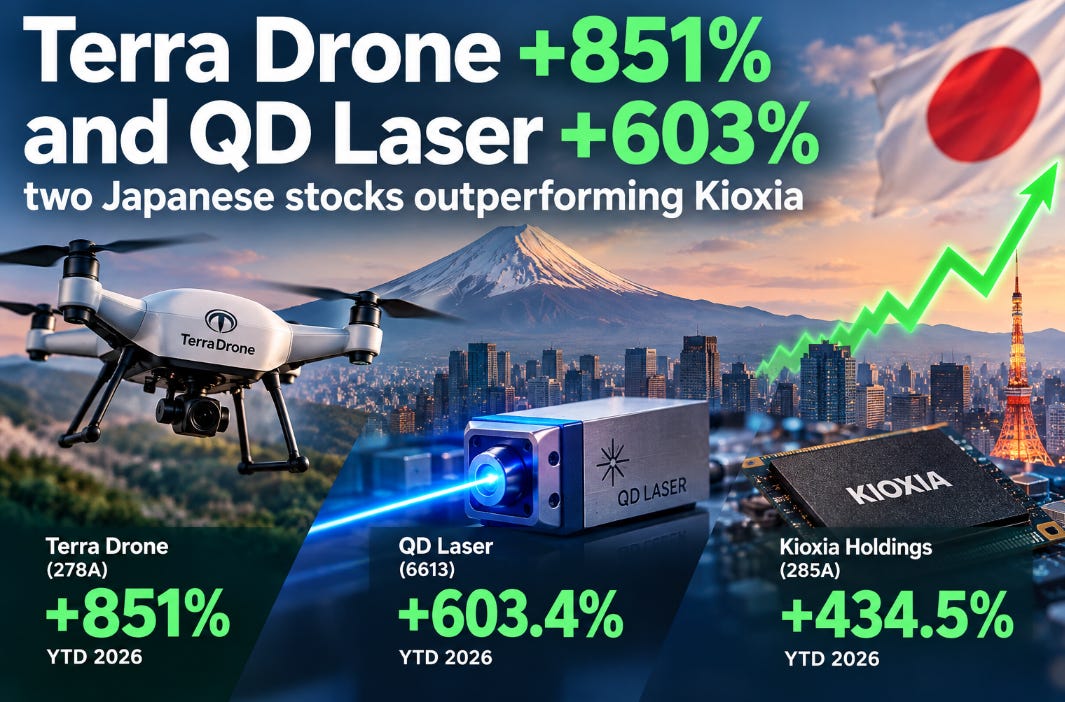
Even Kioxia Holdings (TSE: 285A) has been left behind by Japan’s two biggest stock-market winners of 2026. Kioxia has gained an extraordinary 434.5% year-to-date, but Terra Drone (TSE: 278A) has surged 851%, while QD Laser (TSE: 6613) is up 603.4%.
We have written about Terra Drone before on DividendJapan.com, and the latest numbers make the rally even more remarkable. Terra Drone is still loss-making and its revenue is growing at a relatively modest pace, while QD Laser is profitable but trades at more than 200 times estimated earnings. Below we take a closer look at the two stocks that have managed to outperform even Kioxia this year.
Key Points
Terra Drone (TSE: 278A) is up 851% YTD, making it the best-performing Japanese stock in our database.
QD Laser (TSE: 6613) has gained 603.4% in 2026.
Kioxia (TSE: 285A) is up 434.5%, putting it a distant third behind the two smaller companies.
Terra Drone remains loss-making and trades at roughly 40 times sales.
QD Laser is profitable, but its estimated FY2027 P/E is above 200.
Neither Terra Drone nor QD Laser currently pays a dividend.
Follow DividendJapan.com on Google
⭐ Make DividendJapan.com a preferred source on Google:
DividendJapan.com on Google
Terra Drone: an extraordinary 851% gain
Terra Drone (TSE: 278A) is now up an almost unbelievable 851% in 2026, putting it well ahead of every other Japanese stock in our database.
The company provides drone-based services and technology for applications including surveying and infrastructure inspection. Terra Drone also develops unmanned aircraft traffic-management technology as drone usage and advanced air mobility expand.
Its market capitalization has now reached approximately ¥210 billion, equivalent to around $1.3 billion, based on the figures supplied.
The remarkable part is that Terra Drone’s underlying financial growth has been nowhere near the 851% increase in its share price.
For the six months ended July 31, 2026, results released on September 14 showed revenue of ¥2.24 billion, up 15.1% from ¥1.94 billion a year earlier.
The losses, however, increased.
Operating loss widened from ¥681 million to ¥819 million, recurring loss increased from ¥541 million to ¥695 million, and the net loss grew from ¥394 million to ¥680 million. EPS deteriorated from a loss of ¥41.61 to a loss of ¥69.26 per share.
For the full fiscal year ending January 31, 2027, Terra Drone forecasts:
Revenue of ¥5.07 billion, up 6.1%
Operating loss of ¥1.66 billion
Recurring loss of ¥1.42 billion
Net loss of ¥1.27 billion
EPS of -¥131.88
Dividend of ¥0
The earlier analyst figure of approximately ¥5.3 billion in revenue would represent growth of roughly 10.8%. So to clarify the units: Terra Drone generates revenue in the billions of yen, not trillions.
Growth is expected to accelerate, but gradually
Revenue growth is expected to pick up over the next few years. Based on the estimates supplied, however, analysts are not expecting annual revenue growth to move much beyond 20% even toward FY2029.
That makes the current valuation particularly striking.
At a share price of ¥19,530, Terra Drone trades at approximately 40 times sales. Because the company continues to report losses, there is no meaningful P/E ratio.
There is also no analyst consensus for Terra Drone: according to the data supplied, no analysts currently provide a formal rating on the stock.
And despite the enormous share-price gain, there is still no dividend.
Terra Drone stock split takes effect
One important event takes place overnight. Terra Drone has an ex-date of September 29 for its stock split, which will reduce the nominal share price from the current ¥19,530 to below ¥10,000 on a split-adjusted basis.
This is part of a much broader development in Japan. At the end of September, no fewer than 53 Japanese companies are conducting stock splits.
That is relevant because Japanese shares are generally traded in 100-share units. At ¥19,530, a standard Terra Drone trading unit represents almost ¥2 million. Lower nominal prices following stock splits make these shares accessible with considerably less capital.
We will look at this remarkable wave of Japanese stock splits separately.
QD Laser: +603% with a very different financial profile
The number-two performer is QD Laser (TSE: 6613).
QD Laser has gained 603.4% in 2026, another extraordinary return, although it remains well behind Terra Drone’s 851%.
The company was established in 2006 and grew out of semiconductor-laser technology developed at Fujitsu Laboratories. QD Laser listed in Tokyo in 2021 and develops semiconductor lasers and related optical technologies, including quantum-dot laser technology.
Its products and technology have applications in fields including communications, data centers and other advanced optical applications. QD Laser also develops retinal-projection technology.
The company is considerably smaller than Kioxia and currently has a market capitalization of approximately ¥92 billion, or $586 million.
QD Laser is profitable, but valuation has exploded
Financially, QD Laser differs substantially from Terra Drone because QD Laser is profitable.
Revenue development had been relatively modest in recent years, generally running at approximately 4% to 7–8% annually.
Analysts now expect a significant acceleration.
For FY2027, which ends in March 2027, analyst consensus points to revenue growth of more than 33%. Double-digit revenue growth is also expected in subsequent years.
QD Laser furthermore has a strong balance sheet, with more cash than debt.
The enormous stock rally has nevertheless pushed its valuation to an exceptional level. Based on estimated FY2027 earnings, QD Laser now trades at a P/E ratio above 200.
Like Terra Drone, QD Laser does not pay a dividend.
And then there is Kioxia
Putting the numbers next to each other shows just how unusual 2026 has been:
Terra Drone (TSE: 278A): +851%
QD Laser (TSE: 6613): +603.4%
Kioxia Holdings (TSE: 285A): +434.5%
A gain of more than 400% would normally make Kioxia one of the unquestioned stars of the Japanese market. This year, it isn’t even close to the top two.
Kioxia is also undergoing a stock split overnight. Its 1-for-3 split means that the current ¥55,780 share price will become a little over ¥18,000 per share on a split-adjusted basis.
The three stocks nevertheless represent very different businesses and valuations. Terra Drone is still loss-making and trades around 40 times sales. QD Laser has reached profitability but commands a P/E above 200. Kioxia, despite its spectacular 434.5% rally, trades at an estimated P/E below 9 based on the figures we recently discussed.
None of the three currently pays a dividend.
Two stocks we will continue to follow
Terra Drone’s 851% gain is particularly unusual when set against FY2027 guidance for only 6.1% revenue growth and another substantial net loss. QD Laser’s underlying growth outlook is stronger, with analysts expecting revenue to increase more than 33% in FY2027, but its valuation has risen above 200 times estimated earnings.
Both companies therefore enter the final months of 2026 with share prices that have moved much faster than the growth they reported in recent years.
DividendJapan.com will continue following both stocks, alongside Kioxia and the many other Japanese growth and semiconductor names we have covered extensively.
Source: Company financial results and disclosures, combined with the market, consensus and valuation data supplied for this article.
At DividendJapan, we aim to highlight these opportunities and uncover hidden gems that may not yet be on your radar. Stay tuned as we explore Japan’s dividend growth stories and the next generation of market leaders!
Disclaimer: The information provided here is for informational purposes only and should not be considered financial advice. Investors should conduct their own research or consult with a financial advisor before making any investment decisions.