

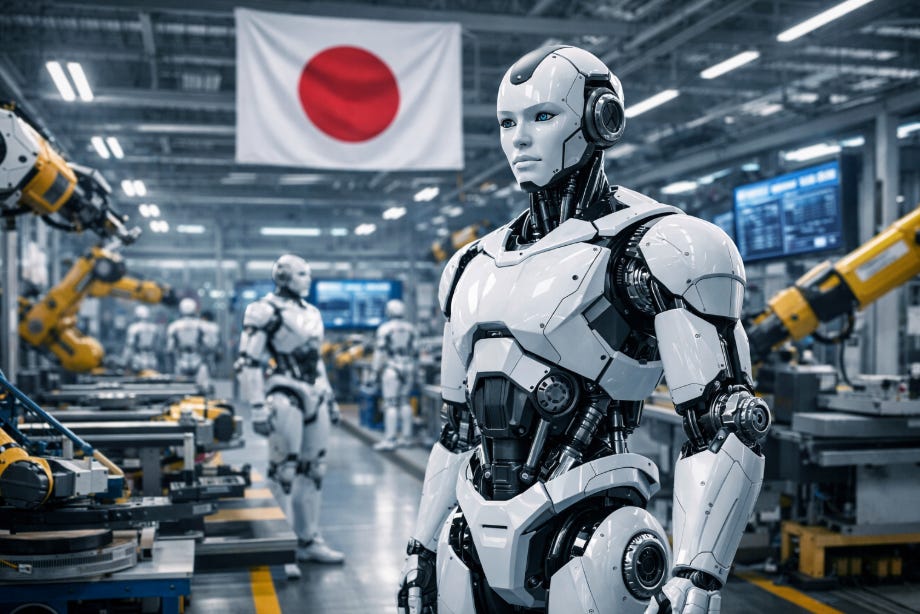
Humanoid robots are moving from early prototypes toward large-scale industrial deployment. According to Barclays, investments in humanoids could rise from roughly $3 billion today to as much as $200 billion by 2035, within a broader physical AI market potentially approaching $900 billion. Japan is structurally positioned in this ecosystem through precision motion and automation specialists such as Harmonic Drive Systems (TSE:6324) and FANUC (TSE:6954).
Key Points in this article
Physical AI could approach $900bn by 2035, with humanoid investment rising from ~$3bn today toward $200bn
China leads deployment with 85% of humanoid installations and 55% of industrial robots
Autonomous vehicles may account for up to $550bn of the total physical AI market
Each humanoid integrates 20–40 actuated joints, driving demand for precision gears and motion systems
Japan is strategically positioned through companies like Harmonic Drive Systems and FANUC
From AI Software to Physical AI
The first AI wave was dominated by semiconductors and hyperscalers. The second wave expands beyond digital infrastructure into mechanical execution: robots that physically interact with the world.
Barclays frames this shift around advances in what it calls “brains, brawn and batteries”:
Computing power enabling real-time AI decision-making
Mechanical precision systems enabling movement
Energy systems providing portable power
Today, humanoid robotics remains a small market of roughly $3 billion in annual investment, but cumulative investment over the coming decade could reach $40 billion, potentially accelerating toward $200 billion by 2035.
The broader physical AI market — including autonomous vehicles, drones and industrial robotics — could reach $500 billion to $1.4 trillion by 2035. Autonomous vehicles alone may account for up to $550 billion, nearly half of that total.
Deployment remains early, but scaling is visible:
Roughly 15,000 humanoid robot installations last year
Over 85% occurred in China
China accounted for 55% of global industrial robot installations in 2024
The U.S. represented approximately 13% of humanoid installations
Acceleration in humanoids is expected after 2030, but industrial robotics and automation are already scaling.
What Makes Humanoid Robots Hardware-Intensive
Humanoid robots differ from traditional industrial robots that perform one repetitive motion. They are designed to operate in human environments with articulated limbs and dynamic balance.
A typical humanoid may include:
20–40 actuated joints
Multiple precision reduction gears per limb
High-torque servo motors
Depth cameras and machine vision systems
Thermal management systems
Battery modules
AI control units

By 2026, humanoids will not possess consciousness or intuition. However, through embodied or “physical” AI, they can autonomously interpret sensor data and execute trained tasks in complex environments such as:
Manufacturing
Food processing
Warehousing
Healthcare assistance
Defense applications (e.g., bomb disposal)
The mechanical complexity creates a substantial addressable market for component suppliers.
Tesla and the Scaling of Production
Tesla TSLA 0.00%↑ is one of the most visible developers through its Optimus platform.
Optimus specifications include:
Height: 1.73 meters
Weight: 57 kg
Walking speed: up to 8 km/h
Lifting capacity: ~20 kg
A third-generation version is expected in 2026, with large-scale production targeted from 2027.
While robots are assembled in Texas, the supply chain is global:
AI chips from Samsung
Sensors from Honeywell (HON)
Precision mechanical components from Schaeffler (Germany)
Actuator systems reportedly linked to Zhejiang Sanhua Intelligent Controls (China)
Zhejiang Sanhua has been associated with actuator-related orders reportedly valued around $685 million, highlighting the scale of mechanical content per robot.
China’s Rapid Expansion
UBTech Robotics has announced annual production capacity exceeding 10,000 robots by 2026, with prior-year orders of approximately 1.4 billion yuan. The company recently signed agreements with Airbus for aircraft manufacturing applications.
Other players in the humanoid ecosystem include:
Boston Dynamics (owned by Hyundai Motor)
Figure AI (valuation reported around $39 billion)
1X Technologies
Automotive companies are heavily involved due to expertise in battery systems, electric drivetrains and high-volume manufacturing.
The Second Wave: Actuators, Gears and Sensors
Barclays argues that the second AI wave broadens the opportunity beyond chips and cloud providers to hardware specialists.
The robotics actuator market is projected to grow at a 10–14% CAGR toward 2030–2034, driven by industrial automation, collaborative robots and autonomous systems.
Companies active in relevant segments include:
Parker Hannifin (PH) — motion control systems and actuators (Parker Hannifin is in the Dividend Hike Portfolio)
Teledyne Technologies (TDY) — sensors, machine vision, FLIR thermal systems
Teradyne (TER) — collaborative robots and AI chip testing
Teradyne’s robotics division is projected to grow at more than 20% annually through 2028, illustrating the interconnection between digital AI infrastructure and physical robotics systems. As demand for AI chips accelerates, the need for advanced semiconductor testing equipment rises in parallel.
An interesting structural detail is that Teradyne and Japan’s Advantest (TSE: 6857) form a global duopoly in Automated Test Equipment (ATE) for the semiconductor industry. Together, the two companies control the vast majority of the global market for testing advanced chips.

As AI-driven semiconductor production expands, this duopolistic position reinforces the strategic link between AI hardware, chip validation and downstream robotics deployment.
Japan’s Strategic Role in Humanoid Robotics
Japan’s positioning is less visible at the branding level, but structurally important at the component level.
Harmonic Drive Systems (TSE: 6324)
Harmonic Drive Systems (TSE: 6324) is a global specialist in high-precision reduction gears used in robotic joints. These systems enable:
High torque density
Minimal backlash
Smooth rotational accuracy
Compact integration
In humanoid robots, precision reduction gears are critical for shoulders, elbows, hips and knees. Since each humanoid integrates multiple high-precision gear assemblies per limb, scaling production directly increases demand for these components.
Japan’s expertise in ultra-precise motion systems places Harmonic Drive at a structurally relevant position in the humanoid value chain. The company itself frames its long-term ambition under the vision of becoming “The best provider of total motion control in harmony with the future.”
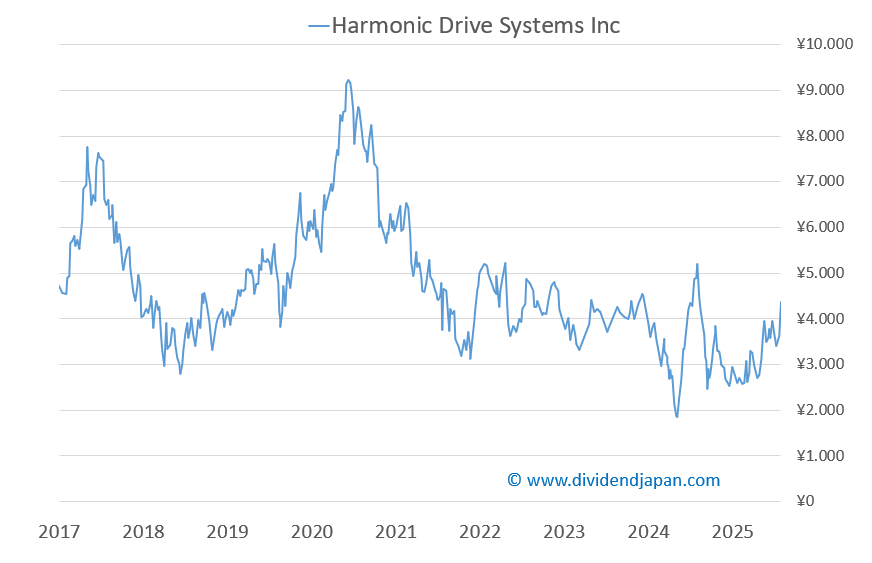
Interestingly, the stock underperformed in both 2024 and 2025, but investors have clearly rediscovered the story in 2026, with the share price up roughly 16% year-to-date. The spotlight intensified last week when the company announced approval from the Tokyo Stock Exchange to transfer its listing from the Standard Market to the Prime Market, effective February 27, 2026. On that news alone, the stock closed 14.7% higher in one session.
At a recent price of ¥4,375, the company has a market capitalization of approximately ¥421 billion (around $2.7 billion). The forward P/E for 2026 is high at roughly 264, reflecting temporarily depressed earnings. However, consensus expects earnings growth to accelerate sharply, bringing the 2027 multiple down toward the mid-80s.
Revenue contracted over the past two fiscal years, but expectations have turned more constructive:
FY2026 (ending March): revenue expected +7.3% to ¥59.7 billion
FY2027: revenue growth around 15%
FY2028: growth above 14%
Profit growth is projected to outpace revenue expansion over the coming years, which partially explains the elevated near-term valuation.
Financially, Harmonic Drive is conservatively structured, reporting no debt and net cash of approximately ¥4.2 billion at year-end 2025. Net cash is expected to increase further in line with growing free cash flow.
The dividend stands at ¥20 annually, implying a yield of roughly 0.5%. Unlike FANUC, Harmonic pays semi-annually, but the dividend has fluctuated in recent years and does not show a consistent growth pattern. The company does not currently repurchase shares.
Analyst sentiment shows divergence: 2 strong buy, 6 buy, 1 hold and 1 strong sell ratings. The dispersion reflects valuation sensitivity after the recent rally.
From a structural perspective, Harmonic Drive is one of the purest listed exposures to humanoid joint mechanics within Japan.
FANUC (TSE: 6954)
FANUC (TSE: 6954) does not produce humanoid robots, but it is one of the world’s largest suppliers of:
Industrial robot arms
CNC systems
Motion control platforms
Factory automation systems
These technologies underpin global manufacturing automation and are transferable to humanoid robotics applications, particularly in motion control and precision actuation.
As of 23 February, FANUC trades around ¥6,421, giving it a market capitalization of approximately ¥6.31 trillion (about $40.7 billion). The stock is up roughly 5.5% year-to-date in 2026, following a 20% gain in 2025.
Revenue development has been weak over the past two years, but consensus expects a return to growth in 2026, with sales projected to rise about 5.5% to ¥841 billion.
The forward P/E is around 37.
One of FANUC’s most distinctive characteristics is its balance sheet: the company is effectively debt-free, holding approximately ¥590 billion in net cash at the end of 2025. It has also consistently repurchased shares in recent years, supporting capital returns.
Another big company from Japan that develops humanoid robots is Kawasaki Heavy Industries (TSE:7012). Kawasaki Heavy Industries has developed humanoid robots, mainly through its Kaleido series, designed for research and human-collaborative tasks. These robots are still experimental, while the company’s main robotics business focuses on industrial manufacturing robots.
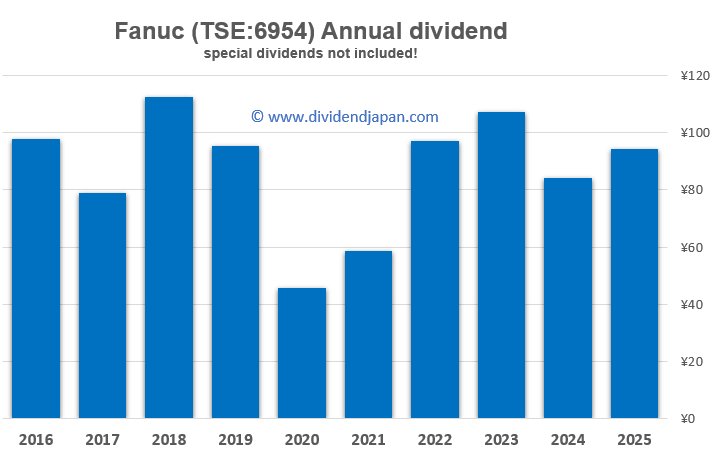
The dividend, however, is variable. The most recent fiscal year dividend of ¥94.39 per share was below the historical peak. The yield currently stands near 1.6%, but payout levels fluctuate depending on earnings.
Analyst coverage is broadly constructive: 2 strong buy, 13 buy, 8 hold and 1 sell recommendations.
Structural Contrast: Harmonic vs FANUC
Both companies experienced revenue pressure over the past two years, but the narratives diverge:
Harmonic Drive offers more direct exposure to humanoid joint mechanics and potential upside from scaling volumes, but at a high valuation and with dividend variability.
FANUC represents a broader industrial automation platform with a fortress balance sheet, steady share buybacks and indirect humanoid leverage through motion control systems.
Both remain debt-free and financially solid, which is notable within capital-intensive manufacturing industries.
he humanoid robotics theme is still early-stage, but the positioning of Japanese component makers is becoming increasingly visible.
Harmonic Drive Systems (TSE: 6324) offers direct exposure to precision reduction gears used in robotic joints. The stock has rebounded strongly in 2026 after two weaker years and recently moved to the Prime Market of the Tokyo Stock Exchange. Revenue growth is expected to reaccelerate over the coming years, while the company remains debt-free. Valuation multiples are elevated, reflecting strong earnings growth expectations.
FANUC (TSE: 6954) operates on a much larger scale, with dominant positions in industrial robots, CNC systems and factory automation. The balance sheet is net cash positive, the company consistently repurchases shares, and revenue growth is expected to recover after two softer years. Dividend payments fluctuate depending on earnings.
Both companies are positioned differently within the robotics ecosystem:
Harmonic Drive: focused precision gear exposure to humanoid joint mechanics
FANUC: broad industrial automation platform with indirect humanoid relevance
The humanoid market itself could expand from roughly $3 billion today toward potentially $200 billion by 2035, within a broader physical AI opportunity approaching $900 billion.
How do you view these two Japanese robotics names within the humanoid growth theme?
Do you prefer the more direct component exposure of Harmonic Drive?
Or the scale, balance sheet strength and automation breadth of FANUC?
Does valuation influence your view at current levels?
Share your thoughts in the comments — I’m curious how the Dividend Japan community sees this emerging robotics cycle.
On Valuation and Momentum
Harmonic Drive’s sharp one-day move (+14.7%) following its Prime Market upgrade highlights how sentiment can shift quickly in Japan, particularly when structural growth narratives gain traction.
FANUC, meanwhile, benefits from scale, net cash strength and recurring automation demand.
The Structural Thesis
Humanoid robots remain early in deployment, but the numbers indicate scaling momentum:
Installations heavily concentrated in China
Industrial robotics expanding globally
Actuator markets growing at double-digit rates
Nearly 200 listed companies mapped across the physical AI ecosystem
If humanoid production expands from thousands to hundreds of thousands — and eventually millions — of units over the coming decade, demand for precision reduction gears, actuators, sensors and motion control systems becomes structurally embedded in the growth trajectory.
Within that framework, Japan’s strength lies in supplying the high-precision mechanical backbone required for humanoid functionality.
At DividendJapan.com, we aim to highlight these opportunities and uncover hidden gems that may not yet be on your radar. Stay tuned as we explore Japan’s dividend growth stories and the next generation of market leaders!
Disclaimer: The information provided here is for informational purposes only and should not be considered financial advice. Investors should conduct their own research or consult with a financial advisor before making any investment decisions.
Japan (the stock market) was closed today because of Emperor's Birthday 'day. Expect Harmonic Drive to make another big jump on Tuesday in Tokio.......
Looks to be a great long term pick