

Tokio Marine (TSE:8766): 15-for-1 Split Opens the Stock to Smaller Investors
Japan’s insurance giant combines a much lower entry price with rapid dividend growth, large buybacks and Berkshire Hathaway as a strategic shareholder
Introduction
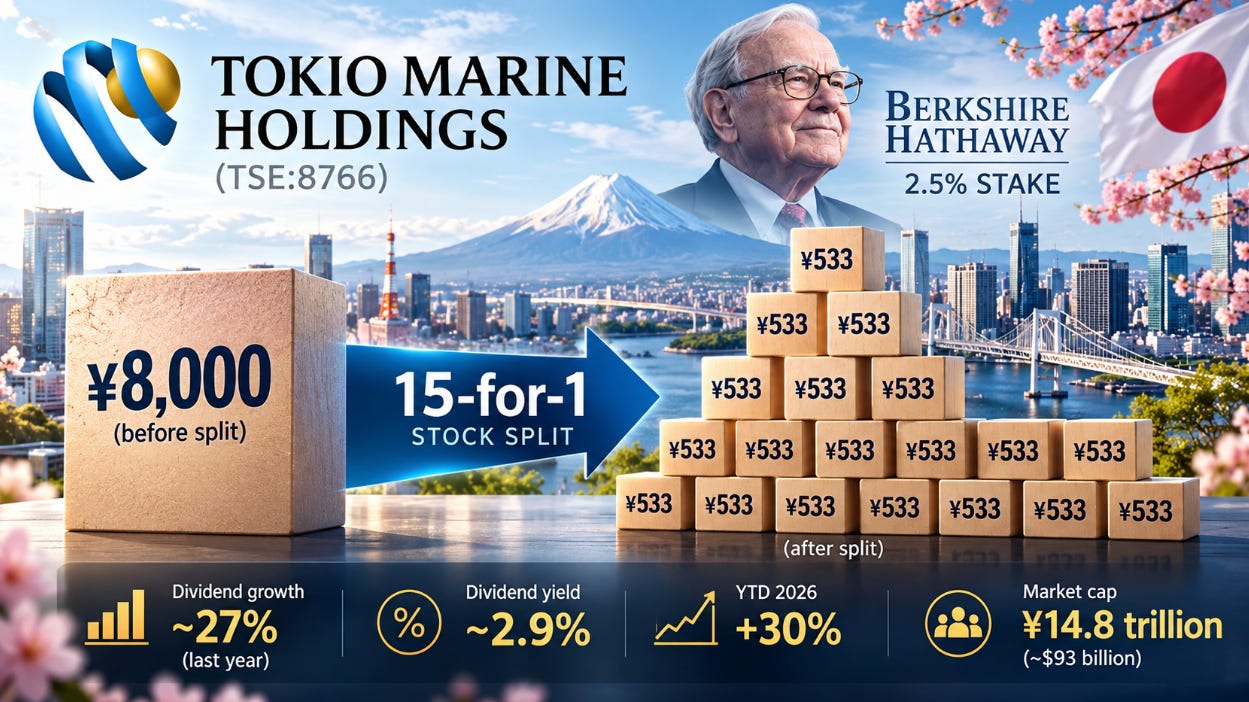
Tokio Marine Holdings (TSE:8766) has completed an enormous 15-for-1 stock split, reducing its share price mechanically from around ¥8,000 to roughly ¥533. The split does not change the value of an investor’s holding, but it dramatically changes accessibility: because Japanese stocks are normally traded in lots of 100 shares, the minimum investment falls from roughly ¥800,000 to just ¥53,300. Meanwhile, Tokio Marine continues to combine a dividend yield of around 2.9% with rapid dividend growth, regular share buybacks and a new strategic partnership with Berkshire Hathaway.
Key Points
15-for-1 stock split cuts the minimum 100-share investment to around ¥53,300
Dividend increased 27% last year, with three-year average growth also around 27%
Berkshire Hathaway acquired an initial 2.5% stake through National Indemnity
Shares are up more than 30% in 2026, with a market cap around ¥14.8 trillion (~$93bn)
Company Overview
Founded in 1879, Tokio Marine became Japan’s first non-life insurance company and started underwriting business in London, Paris and New York as early as 1880. Today, the group employs more than 50,000 people and operates across Japan and international markets in non-life insurance, life insurance and a broad range of specialty insurance and risk-management businesses.
Tokio Marine Holdings (TSE:8766) currently has a market capitalization of approximately ¥14.8 trillion, equivalent to roughly $93 billion, making it one of Japan’s largest listed financial companies.
A Massive 15-for-1 Stock Split
The most striking recent development is Tokio Marine’s 15-for-1 stock split, by far the largest split among the 43 Japanese companies carrying out stock splits around the end of September.
For every old Tokio Marine share, investors now own 15 shares. A share price of around ¥8,000 therefore becomes approximately ¥533 on a split-adjusted basis. Tokio Marine itself confirmed the 15-for-1 ratio in its investor information.
That matters particularly in Japan because the standard trading unit is 100 shares. Before the split, buying a standard lot at ¥8,000 required approximately ¥800,000. At ¥533, the same standard lot requires only around ¥53,300.
For smaller Japanese investors, that substantially lowers the amount of capital needed to add Tokio Marine to a diversified portfolio. It also helps explain why unusually large stock splits can be more consequential in Japan than in markets where investors routinely buy individual or fractional shares.
Berkshire Hathaway Becomes a Shareholder
The split follows another major development earlier in 2026. Berkshire Hathaway, through its core reinsurance subsidiary National Indemnity, made an initial strategic investment representing approximately 2.5% of Tokio Marine’s outstanding shares.
The transaction was completed in April at ¥5,962 per pre-split share and totaled approximately ¥287.4 billion. The partnership extends beyond the equity investment: Tokio Marine and Berkshire are also collaborating in reinsuran
ce and potential M&A opportunities. Berkshire cannot increase its ownership beyond 9.9% without prior approval from Tokio Marine’s board.
Tokio Marine simultaneously launched share repurchases designed to offset dilution from the shares issued to Berkshire. The insurer separately announced plans for up to ¥400 billion of additional FY2026 buybacks, excluding the Berkshire-related repurchase.
Dividend
Dividend growth remains one of the most notable parts of the Tokio Marine story.
The FY2025 dividend increased from ¥172 to ¥218 per pre-split share, an increase of approximately 27%. That follows several years of rapid increases: Tokio Marine paid ¥100 in FY2022, ¥123 in FY2023 and ¥172 in FY2024. The company explicitly states that dividends are the basis of shareholder returns and that its policy is to increase them continuously in line with profit growth.

On a 15-for-1 split-adjusted basis, the FY2025 dividend equals approximately ¥14.53 per share. At the current share price, the trailing dividend yield is close to 3%.
Importantly, FY2025 is not an isolated increase. Tokio Marine’s dividend growth has averaged roughly 27% annually over the last three years, while the company’s official FY2026 forecast before the split was ¥245 per share, equivalent to approximately ¥16.33 after the split.
Share buybacks add another component to shareholder returns. Over the past four years, Tokio Marine has retired or repurchased roughly 2% of its outstanding shares per year on average, while the current FY2026 program is substantially larger.
Financial Performance & Fundamentals
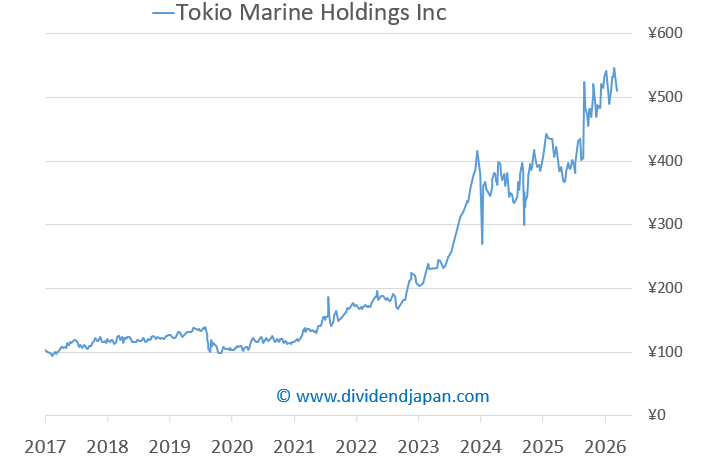
Tokio Marine’s share price has risen strongly alongside its dividend. The stock has gained more than 30% in 2026 and has produced substantial gains over the preceding five years as well.
Despite that performance, the shares trade at an estimated P/E of around 15, based on current earnings forecasts. Tokio Marine’s official figures also show adjusted ROE of 22.0% for FY2025, while its Economic Solvency Ratio stood at 268% at the end of March 2026, above the group’s target of at least 190%.
P/E 2026E: ~15x
Dividend yield: ~2.9%
FY2025 dividend growth: ~27%
Three-year dividend growth: ~27% p.a.
Market cap: ~¥14.8tn / $93bn
2026 share-price performance: >+30%
Analyst View
Analyst sentiment remains strongly positive, with 3 Strong Buy, 9 Buy and 3 Hold ratings, and no Sell recommendations.
Tokio Marine’s rapid share-price appreciation means valuation has increased, but the estimated P/E remains around 15. The combination of the split, dividend growth and buybacks also means investors are now looking at very different per-share figures than before October, even though the underlying economics of the company were unchanged by the split itself.
Summary
Tokio Marine Holdings (TSE:8766) enters the final months of 2026 with one of the most dramatic stock splits seen in Japan this year. The 15-for-1 split reduces the minimum cost of a standard 100-share lot from roughly ¥800,000 to around ¥53,300, making the stock substantially more accessible to smaller investors.
At the same time, the underlying shareholder-return story remains notable. The dividend increased approximately 27% last year, the three-year dividend growth rate is around 27% annually, the yield is close to 3%, and Tokio Marine continues to deploy significant capital through share repurchases. Berkshire Hathaway’s 2.5% strategic investment adds another important development to the company’s 2026 story.
At around 15 times estimated earnings, Tokio Marine combines a much lower post-split share price with rapid dividend growth and substantial capital returns. The stock split itself creates no economic value, but it fundamentally changes the amount of capital Japanese retail investors need to own a standard trading lot.
On your final question — would I buy it like Buffett? — I’d keep that out of the Dividend Japan article because your format is deliberately factual rather than advisory. The relevant facts for that decision are now clearly laid out: ~15x estimated earnings, ~2.9% yield, very high recent dividend growth, substantial buybacks, strong recent share-price performance and Berkshire’s 2.5% strategic stake.
At DividendJapan, we aim to highlight these opportunities and uncover hidden gems that may not yet be on your radar. Stay tuned as we explore Japan’s dividend growth stories and the next generation of market leaders!
Disclaimer: The information provided here is for informational purposes only and should not be considered financial advice. Investors should conduct their own research or consult with a financial advisor before making any investment decisions.