

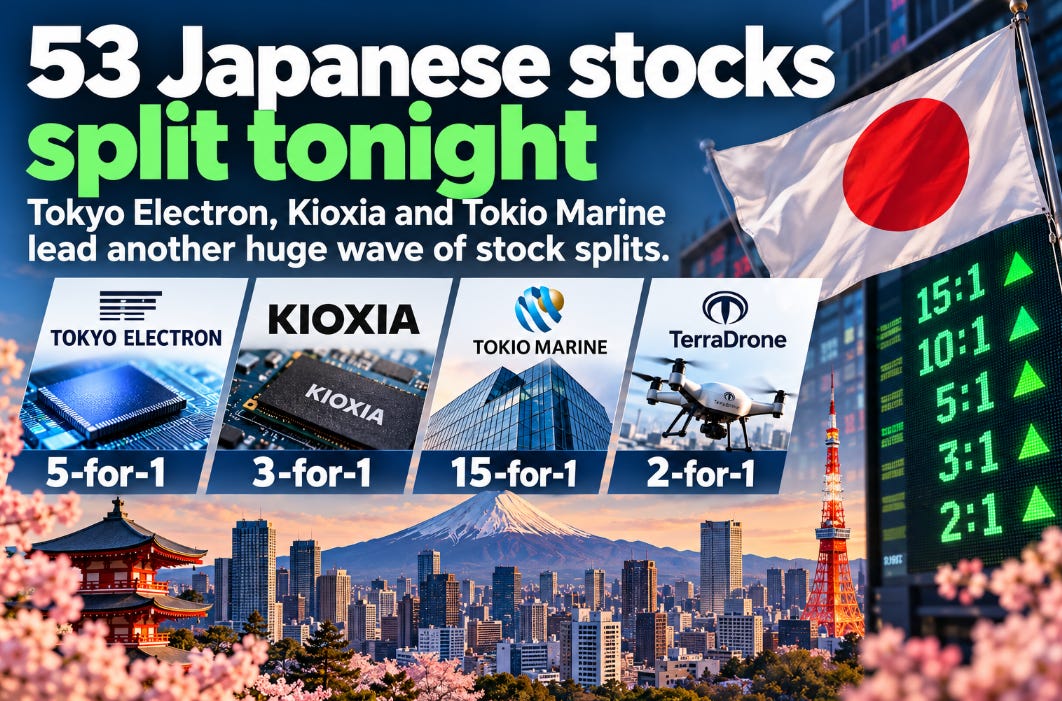
Japan is about to see another extraordinary wave of stock splits. No fewer than 53 Tokyo-listed companies will adjust their shares at the end of September, including some of Japan’s biggest and best-known companies. Among them are Tokyo Electron, Kioxia Holdings, Tokio Marine Holdings, Sumitomo Mitsui Financial Group, Daiwa House and Terra Drone. The official JPX schedule confirms that the allotments take place at the end of September 2026.
For Japanese investors, this matters more than it might in the U.S. or Europe. Tokyo-listed shares are generally traded in lots of 100 shares, meaning a stock trading at ¥50,000 requires roughly ¥5 million just to purchase a standard lot. Splitting expensive shares can therefore substantially lower the amount of money needed to establish a position.
Key points
53 Japanese companies are carrying out stock splits at the end of September.
Tokio Marine (TSE: 8766) has the largest split among the major names at 15-for-1.
Tokyo Electron (TSE: 8035) executes a 5-for-1 split after its spectacular share-price rally.
Kioxia (TSE: 285A) splits 3-for-1, bringing its recent ¥55,780 price to roughly ¥18,593 on a split-adjusted basis.
Terra Drone (TSE: 278A) splits 2-for-1 after gaining an incredible 851% in 2026.
Mitsui Kinzoku and Hokuhoku Financial Group are conducting 10-for-1 splits.
Every company on the JPX list currently has a standard trading unit of 100 shares.
🇯🇵 Make DividendJapan.com a preferred source on Google:
Follow DividendJapan.com on Google
Japan’s stock-split boom continues
This isn’t the first time we have written about Japan’s unusually high number of stock splits.
At the end of March 2025, nearly 50 Japanese companies split their shares. In the first quarter of 2026, that number had already climbed above 60. DividendJapan highlighted Fujikura’s 6-for-1 split earlier this year after the semiconductor-related stock subsequently continued to set new records.
Even the final trading day of 2025 produced more than 30 splits, including major companies such as SoftBank, Itochu and Bridgestone.
Now another 53 companies are joining the list at the end of September.
The scale is remarkable, but there is a logical reason behind it. A stock split doesn’t change a company’s underlying market capitalization or the economic value of an investor’s holding. It simply divides the same ownership into a larger number of shares at a proportionally lower price.
In Japan, however, that lower nominal price can have a particularly practical effect because of the standard 100-share trading unit.
Tokyo Electron finally becomes much more accessible
One of the standout names is Tokyo Electron (TSE: 8035), which is carrying out a 5-for-1 stock split.
This is especially relevant because we recently highlighted exactly this problem in our article Tokyo Electron nears record high as AI demand drives growth expectations.
Tokyo Electron had climbed to around ¥68,000 by June after trading near ¥20,000 in September 2025. At ¥68,000, purchasing the standard 100-share lot would require approximately ¥6.8 million.
A 5-for-1 split takes a ¥68,000 share price to an equivalent ¥13,600, reducing the capital needed for 100 shares from ¥6.8 million to roughly ¥1.36 million.
Nothing changes about the value of the company because of the split itself, but the difference for smaller investors is substantial.
Tokyo Electron has been one of the major beneficiaries of the semiconductor and AI investment boom. As we recently wrote, the company competes with U.S. semiconductor-equipment giants including Applied Materials, Lam Research and KLA. Its shares had gained dramatically before the split.
Kioxia goes 3-for-1 after an extraordinary rally
Then there is Kioxia Holdings (TSE: 285A).
Kioxia is executing a 3-for-1 stock split. At the recent price of ¥55,780, that translates into a theoretical split-adjusted price of approximately ¥18,593.
DividendJapan readers will know Kioxia very well.
We first highlighted the semiconductor company in 2025 when shares were around ¥3,500. We subsequently returned to the stock several times as it became one of Japan’s most spectacular semiconductor performers. Our original Kioxia article
By October 2025, the stock had already risen about 150% from our original article, prompting another update: Kioxia – Japan’s best-performing semiconductor stock in 2025.
And Kioxia hasn’t stopped there. In 2026 the stock has gained another 434.5% based on our latest figures.
The 3-for-1 split therefore arrives after an extraordinary appreciation in the nominal share price.
Terra Drone splits after an 851% explosion
Another familiar DividendJapan name is Terra Drone (TSE: 278A).
Terra Drone will conduct a 2-for-1 split, cutting its recent ¥19,530 share price to a theoretical ¥9,765.
We first wrote extensively about Terra Drone and Japan’s listed drone industry when the company was still a much smaller stock.
What happened subsequently has been extraordinary: Terra Drone is now up approximately 851% in 2026, making it the best-performing Japanese stock in our current database.
The stock-market performance is even more remarkable considering that Terra Drone remains loss-making and its underlying revenue growth is nowhere near its share-price appreciation.
The split will at least bring the nominal share price back below ¥10,000, significantly lowering the cost of a standard 100-share position.
Tokio Marine goes even further: 15-for-1
Perhaps the most eye-catching split of the entire group comes from Tokio Marine Holdings (TSE: 8766).
Japan’s insurance giant is carrying out an enormous 15-for-1 split — the largest ratio on the September list supplied.
Tokio Marine is another company DividendJapan has followed closely. Earlier this year, the stock surged after Berkshire Hathaway’s National Indemnity agreed to take a 2.5% stake worth approximately $1.8 billion.
At the time, we also highlighted Tokio Marine’s impressive dividend record, including double-digit dividend growth. Tokio Marine Holdings is a dividend growth machine
The 15-for-1 split is considerably larger than the ratios chosen by most other companies this month.
Banks, semiconductors and industrial companies join in
The September list is unusually broad.
Sumitomo Mitsui Financial Group (TSE: 8316) is carrying out a 2-for-1 split, while several regional banks are going much further. Akita Bank, Yamanashi Chuo Bank and Awa Bank are each splitting 5-for-1, while Hokuhoku Financial Group is going 10-for-1.
The technology and semiconductor supply chain is also strongly represented.
Besides Tokyo Electron and Kioxia, IBIDEN (TSE: 4062) goes 2-for-1, Organo (TSE: 6368) goes 5-for-1 and Tera Probe (TSE: 6627) also splits 5-for-1.
Other recognizable names include Daiwa House Industry with a 2-for-1 split, Isetan Mitsukoshi Holdings at 2-for-1, Niterra at 2-for-1 and TOPPAN Holdings at 2-for-1.
Two companies besides Tokio Marine stand out for particularly large ratios: Mitsui Kinzoku and Hokuhoku Financial Group both execute 10-for-1 splits.
The complete official list is available from the Japan Exchange Group (JPX).
A welcome development for Japanese investors
The sheer number of stock splits has become one of the more distinctive developments in Japan’s equity market.
For international investors accustomed to buying a single share, Japan’s 100-share trading units can still be frustrating. A ¥50,000 stock effectively creates a ¥5 million threshold for purchasing a normal lot.
Tokyo Electron is a perfect illustration. Its rally from around ¥20,000 to roughly ¥68,000 made the stock dramatically more expensive to access even though the underlying investment case had not changed simply because the nominal share price increased.
The same applies to Kioxia and, after its enormous rally, Terra Drone.
A stock split doesn’t make any of these companies fundamentally cheaper. Valuations, earnings, dividends and market capitalizations are unchanged immediately after a split. But it does make the shares far more accessible, and with 53 companies taking action at the end of September alone, Japanese companies are clearly continuing to address the country’s unusually high minimum investment amounts.
At DividendJapan, we aim to highlight these opportunities and uncover hidden gems that may not yet be on your radar. Stay tuned as we explore Japan’s dividend growth stories and the next generation of market leaders!
Disclaimer: The information provided here is for informational purposes only and should not be considered financial advice. Investors should conduct their own research or consult with a financial advisor before making any investment decisions.