


Japan’s stock market is home to some extraordinary companies, many of which remain relatively unfamiliar to international investors. In 2026, a loss-making drone manufacturer has delivered one of the country’s biggest share-price gains, semiconductor stocks have reached remarkable valuations, and established businesses have continued returning billions to shareholders through dividends and buybacks.

From artificial intelligence and industrial automation to insurance, sportswear and international trading, Japan offers a much broader range of listed companies than the familiar names in the automotive and electronics industries might suggest.
This is the first in a series of DividendJapan articles exploring the Japanese stock market, the companies behind its recent performance and the characteristics that make investing in Japan different from investing in Europe or the United States.
Key points
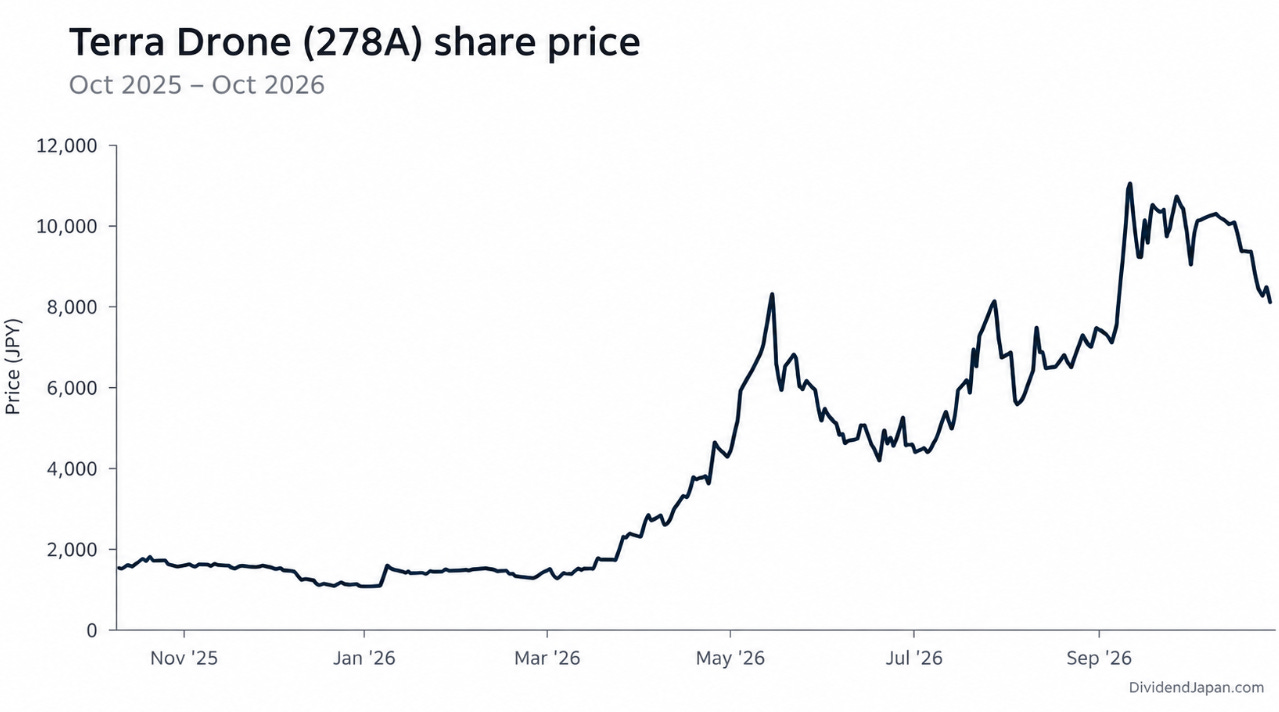
Terra Drone: One of Japan’s biggest stock-market winners in 2026, with a gain of approximately 850% by late September, despite continuing losses.
Warren Buffett: Berkshire Hathaway owns major positions in Japan’s five leading trading houses and acquired a 2.5% stake in Tokio Marine in 2026.
AI and semiconductors: Kioxia and Fujikura illustrate how Japanese companies are benefiting from demand for data storage and AI infrastructure.
Dividend growth: Fujikura increased its dividend by 125% for the financial year ended March 2026, while Kao has raised its annual dividend for 36 consecutive years.
Hidden giants: Keyence and Murata Manufacturing are two major Japanese technology companies that many international investors may not immediately recognize.
Terra Drone: an 850% rally without a profit
One of the most remarkable stories on the Tokyo Stock Exchange this year is Terra Drone (TSE: 278A).
By late September, the company’s shares had gained approximately 850% in 2026, making it the biggest Japanese stock-market winner in our database at that point. Terra Drone’s market capitalization had climbed to well over $1 billion, even though the business was still reporting losses.
The company’s activities extend far beyond conventional commercial drones. Terra Drone provides industrial inspection, surveying and mapping services, while increasingly developing technology for defense applications.
One particularly notable development is its range of interceptor drones, designed to destroy hostile unmanned aircraft. In June, the company announced successful tests against Shahed-type drones.
That expansion into defense technology has given investors a very different way of looking at the company compared with its original industrial-drone activities.
The contrast between the share-price performance and the company’s financial results is important, however. An 850% increase in the share price does not mean revenue or profits have risen by anything close to the same percentage.
Terra Drone also completed a 2-for-1 stock split at the end of September, following its extraordinary rally. We previously examined the company’s business in more detail in our article on Japan’s listed drone manufacturers.
Keyence and Murata: two Japanese technology giants
Not every major Japanese technology company attracts the same international attention as Sony, Nintendo or Toyota.
Two examples are Keyence (TSE: 6861) and Murata Manufacturing (TSE: 6981), companies with market capitalizations running into tens of billions of dollars.
Keyence is one of the world’s leading specialists in factory automation and industrial inspection. It develops sensors, machine-vision systems, measuring instruments, microscopes and other equipment used to automate manufacturing processes and monitor product quality.
These technologies are used across industries ranging from automotive manufacturing and electronics to pharmaceuticals and food production.
Murata Manufacturing operates in a different part of the technology market. The company produces electronic components and is a global leader in multilayer ceramic capacitors, better known as MLCCs.
These miniature components store and release electrical energy and help regulate electrical circuits. They are essential in smartphones, computers, cars, industrial machinery and countless other electronic devices.
According to Murata’s own company information, its global market share in ceramic capacitors is approximately 40%.
Both companies illustrate an important characteristic of the Japanese market: some of its largest businesses are suppliers of components, equipment and technologies that consumers rarely encounter directly, despite their widespread use in products manufactured worldwide.
Why Warren Buffett invested billions in Japan’s trading houses
Another distinctive feature of the Japanese market is the presence of the enormous diversified trading companies known as sogo shosha.
These businesses are much more than traditional importers and exporters. They operate worldwide, investing in energy, commodities, food, retail, infrastructure, logistics and numerous industrial activities.
In many respects, they function as diversified engines of the Japanese economy, connecting Japanese businesses with international suppliers, customers and investment opportunities.
The five largest names are Mitsubishi Corporation, Mitsui & Co., Itochu Corporation, Marubeni Corporation and Sumitomo Corporation.
Warren Buffett began building Berkshire Hathaway’s positions in these companies years ago, attracted in part by their diversified operations, cash generation and approach to shareholder returns.
The scale of Berkshire’s investment has since become substantial.
According to Berkshire Hathaway’s 2025 annual report, its five Japanese trading-house positions were worth a combined $35.4 billion at the end of 2025. They generated approximately $862 million in dividends during that year.
Berkshire’s stakes in the individual companies ranged from 9.7% to 10.8%.
A smaller trading company worth mentioning is Toyota Tsusho (TSE: 8015), which has also experienced a substantial share-price increase in recent years.
Toyota Tsusho operates internationally across automotive-related activities, metals, machinery, energy, chemicals and other businesses. It has particularly close connections with the Toyota group.
Its dividend development provides another example of changing shareholder-return policies in Japan.
On a split-adjusted basis, Toyota Tsusho’s annual dividend increased from ¥53.33 for the financial year ended March 2022 to ¥120 for March 2026. The company currently forecasts ¥125 for March 2027.
That represents more than a doubling over four completed financial years.
Toyota Tsusho has also introduced a progressive dividend policy and targets a total shareholder-return ratio of at least 40%, including share repurchases, under its current medium-term framework.
These figures are available in the company’s official shareholder information.
Tokio Marine: Berkshire’s new insurance investment
Berkshire Hathaway’s interest in Japanese companies is no longer limited to the major trading houses.
In March 2026, its insurance subsidiary National Indemnity agreed to acquire a 2.5% stake in Tokio Marine Holdings (TSE: 8766).
As previously reported by DividendJapan, the investment represented a significant expansion of Berkshire’s Japanese equity exposure.
Tokio Marine is one of Japan’s largest insurance groups, operating internationally in property and casualty insurance, life insurance and reinsurance.
It also has an extensive history of returning capital to shareholders.
Over the past five years, annual dividend growth has averaged approximately 23%, based on our earlier company analysis. Recent shareholder-return programs have also included substantial share repurchases.
At a recent market price, the dividend yield was around 3%.
Tokio Marine was also responsible for one of the most unusual corporate actions of 2026: a 15-for-1 stock split at the end of September.
A share trading around ¥8,000 before the split would have an equivalent theoretical price of roughly ¥533 afterward.
The large split ratio substantially reduced the amount of money needed to acquire the standard trading lot of 100 shares on the Tokyo Stock Exchange.
Importantly, a split does not change the economic value of the company or an existing investor’s holding. The number of shares increases, while the price and dividend per share are adjusted proportionally.
We examined the transaction and dividend implications in our recent article, Tokio Marine’s stock split and dividend growth.
Kioxia: one of Japan’s biggest AI success stories
Few Japanese semiconductor stocks have attracted as much attention in recent years as Kioxia Holdings (TSE: 285A).
The company specializes in NAND flash memory, the technology used to store data in smartphones, solid-state drives, enterprise storage systems and data centers.
The expansion of AI infrastructure has increased attention on memory and storage technology. Although powerful processors perform AI calculations, enormous quantities of data also need to be stored and accessed efficiently.
Kioxia is particularly exposed to the storage side of this market.
There is an important distinction between Kioxia and American memory-chip manufacturer Micron Technology.
Kioxia focuses on NAND flash memory, which retains information without a continuous power supply. Micron manufactures both NAND and DRAM, with DRAM primarily serving as high-speed working memory.
Following an extraordinary share-price rally, Kioxia’s market capitalization approached $180 billion in early October 2026, placing it among Japan’s largest listed companies.
The company also executed a 3-for-1 stock split at the end of September, making its shares more accessible to Japanese retail investors.
Unlike many of the other companies discussed here, Kioxia does not currently pay a dividend. Its stock-market performance is therefore a story about business growth, industry expectations and valuation rather than income generation.
DividendJapan first highlighted the company in 2025 and subsequently revisited its performance in our article Kioxia: Japan’s best-performing semiconductor stock in 2025.
Further information on the underlying business is available from Kioxia Holdings.
Fujikura: extraordinary AI growth and a 125% dividend increase
Another company that deserves particular attention is Fujikura (TSE: 5803), one of Japan’s biggest stock-market success stories of recent years.
Fujikura manufactures cables, optical fibers, connectors and other electronic and telecommunications components.
Its growing exposure to data centers and AI infrastructure has become a major driver of its business.
As AI systems require increasingly powerful computing networks, demand for high-speed connections between servers and data centers has increased substantially. Fujikura supplies important parts of that underlying infrastructure.
The company’s share-price performance has been extraordinary.
Fujikura gained 504% in 2024 and another 174% in 2025. By late September 2026, the stock had added approximately 86% since the beginning of the year.
Taken together, these gains have transformed Fujikura into a company with a market capitalization exceeding $50 billion.
A significant proportion of its business is connected to North America, which accounts for close to half of group revenue.
The financial outlook also changed substantially during 2026.
Following its first-quarter results in August, Fujikura raised its full-year revenue forecast for the financial year ending March 2027 to ¥1.755 trillion, an increase of 48.4% compared with the previous year.
The company expects operating profit to increase even faster, benefiting from expanding demand for optical components used in data centers.
Fujikura’s remarkable dividend growth
Fujikura’s dividend history is almost as striking as its share-price performance.
For the financial year ended March 2026, the company increased its annual dividend from ¥100 to ¥225 per share, an increase of 125%.
Fujikura implemented a 6-for-1 stock split effective April 1, 2026. On a post-split basis, the annual dividend therefore increased from approximately ¥16.67 to ¥37.50.
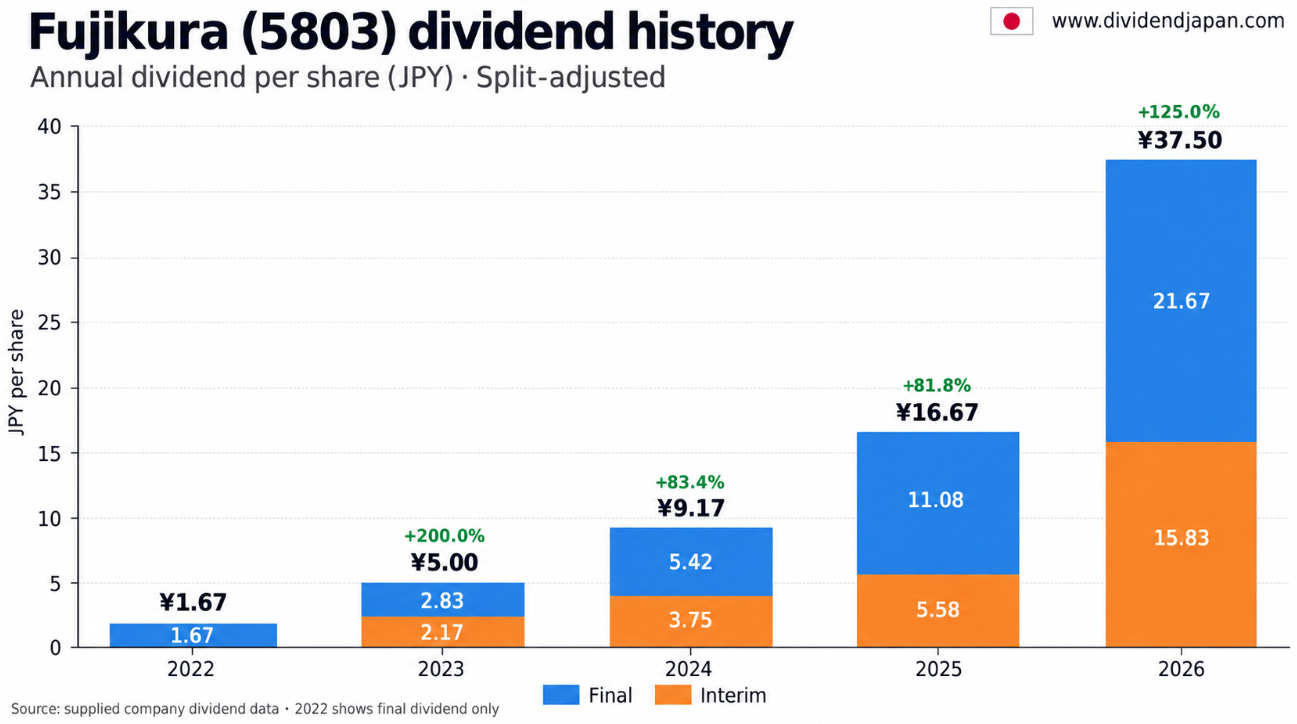
That represents an exceptionally rapid increase in shareholder distributions over a relatively short period.
However, it is important to distinguish between the dividend already paid for the previous financial year and the dividend currently forecast for the new one.
For the financial year ending March 2027, Fujikura’s published dividend forecast is ¥38 per share, consisting of two expected payments of ¥19.
Compared with the previous year’s split-adjusted dividend of ¥37.50, this would represent an increase of only 1.3%.
This is an important reminder that exceptionally high historical dividend growth does not automatically continue at the same pace.
At a share price around ¥5,413, Fujikura’s projected annual dividend of ¥38 translates into a yield of approximately 0.7%. Using the company’s projected earnings per share of ¥196.88, the forward price-to-earnings ratio would be approximately 27.5.
Fujikura has attracted comparisons with American connectivity specialist Amphenol, another company benefiting from investment in AI-related infrastructure.
An unusual feature of Japanese dividends
Fujikura also provides a useful example of how dividend announcements can work in Japan.
The company distributes dividends twice a year, with record dates on March 31 and September 30.
For the September 2026 interim dividend, shares traded ex-dividend on September 29. However, the ¥19 payment was still a forecast, rather than a finally approved dividend, at that point.
Japanese companies can announce estimated dividends in advance and confirm the actual amount later.
Consequently, investors may encounter an ex-dividend date before the final payment has been formally determined.
In Fujikura’s case, interim dividends are generally paid in December, while year-end dividends are paid in June.
DividendJapan previously covered the company’s 6-for-1 stock split and record dividend growth. Additional details can be found in Fujikura’s official investor-relations section and its shareholder-return information.
ASICS and Kao: two very different dividend stories
Japan’s stock-market successes are not limited to semiconductors, industrial technology and financial companies.
ASICS (TSE: 7936) is an interesting example from the consumer sector.
The sportswear and running-shoe manufacturer has expanded substantially outside Japan, with international markets accounting for more than 80% of sales.
ASICS has recorded double-digit sales growth in recent years, supported by demand for its performance running shoes and the development of its international business.
In contrast with the difficulties experienced by several established international sportswear competitors, ASICS shares have performed well and were trading near their historical highs in the recent market snapshot.
At approximately ¥4,450 per share, the company had a market capitalization approaching $20 billion, a forward earnings multiple of around 25 and a dividend yield of approximately 0.8%.
ASICS has also increased shareholder distributions and announced further share-repurchase programs in 2026.
The latest official announcements can be found on its investor-relations website.
At the other end of the dividend spectrum is Kao Corporation (TSE: 4452).
Kao is one of Japan’s most established consumer-products groups, manufacturing household goods, personal-care products, cosmetics and hair-care products.
Its international brands include John Frieda, Guhl and Goldwell.
What makes Kao particularly notable is its dividend history.
The company has increased its annual dividend for 36 consecutive years through 2025, giving it one of the longest dividend-growth records among Japanese listed companies.
Kao expects to extend that streak further in 2026.
Yet its recent share-price performance and dividend growth have been relatively modest compared with the exceptional increases reported by companies such as Fujikura.
Kao therefore offers an entirely different example of dividend investing in Japan: a long and consistent dividend history, but a much slower recent growth rate.
The latest distribution figures are available on Kao’s official shareholder-return page.
What these companies reveal about investing in Japan
The examples above illustrate just how diverse Japan’s stock market has become.
On one side are high-growth businesses such as Terra Drone, Kioxia and Fujikura, whose share prices have risen dramatically as investors reassess their growth prospects.
On another are established international businesses such as Keyence, Murata and ASICS, which participate in major global markets without necessarily being household names outside Japan.
Then there are the diversified trading houses and insurers favored by Berkshire Hathaway, where dividends, cash generation and capital returns play a central role.
Finally, companies such as Kao demonstrate that Japan also has a substantial group of businesses with exceptionally long dividend histories, even when recent earnings or dividend growth is limited.
These differences matter when comparing Japanese shares.
A spectacular share-price increase is not necessarily accompanied by similar revenue or earnings growth. A high dividend yield does not automatically indicate a rapidly growing dividend, while a company with decades of consecutive increases may currently be raising its distribution by only a small percentage.
Corporate actions also require attention. Japan’s numerous stock splits can significantly reduce the price per share and the cost of buying a standard 100-share trading lot, without changing the value of the underlying business.
Dividend histories, earnings figures and valuations should therefore be compared on a split-adjusted basis.
For international investors, the yen introduces another consideration: investment returns measured in euros or dollars can differ substantially from returns measured in Japanese currency.
These are among the characteristics we will explore in more detail in our upcoming educational articles about investing in Japan.
At DividendJapan, we aim to highlight these opportunities and uncover hidden gems that may not yet be on your radar. Stay tuned as we explore Japan’s dividend growth stories and the next generation of market leaders!
Disclaimer: The information provided here is for informational purposes only and should not be considered financial advice. Investors should conduct their own research or consult with a financial advisor before making any investment decisions.