


Japan faces a remarkable economic challenge. Its currency has fallen to levels not seen in roughly four decades, government debt remains among the highest in the world, and the population continues to shrink and age. Yet Japanese companies are investing in new technologies, wages are rising, and several industries are experiencing substantial growth.

How can an economy with these characteristics continue to expand? And perhaps more importantly for investors, does Japan’s slow economic growth necessarily mean that Japanese listed companies face the same limitations?
The answer largely comes down to one crucial concept: productivity.
This is the second article in our educational series about investing in Japan, following our recent look at Japan’s standout stocks in 2026.
Key points
Weak yen: Japan’s policy interest rate has reached 1.25%, its highest level since 1995, but remains well below US and European rates.
Government debt: Public debt is equivalent to approximately 200% of GDP, complicating Japan’s combination of monetary normalization and expansionary fiscal policy.
Aging population: Japan has approximately 123 million residents, with almost 30% aged 65 or older.
Limited economic growth: The OECD forecasts real GDP growth of just 0.6% in 2026 and 0.8% in 2027.
New growth drivers: Automation, robotics, AI, productivity improvements and internationally operating Japanese companies are central to Japan’s economic outlook.
Why the Japanese yen has fallen so dramatically
One of the defining features of Japan’s economy in recent years has been the persistent weakness of the Japanese yen.
During 2026, the currency fell to its lowest level against the US dollar in approximately 40 years, continuing a prolonged period of depreciation.
The most important structural explanation is the difference between Japanese interest rates and those in other major economies.
Japan maintained exceptionally low interest rates for decades to support an economy characterized by weak inflation, limited domestic demand and slow growth.
Although the Bank of Japan has gradually changed course, interest rates remain comparatively low.
Following another increase in September, the Bank of Japan now maintains a policy rate of 1.25%, its highest level since 1995.
For comparison, the US Federal Reserve raised its target range to 3.75–4.00% in September 2026, while the European Central Bank increased its deposit facility rate to 2.50%.
These differences remain significant, even after Japan’s recent increases.
How the carry trade puts pressure on the yen
A particularly important mechanism behind currency movements is the yen carry trade.
The basic principle is relatively straightforward.
Investors borrow money in a currency with low interest rates, such as the Japanese yen, and invest the proceeds in assets denominated in currencies offering higher yields.
For example, an investor can borrow yen at a relatively low cost, exchange those yen for US dollars and invest in higher-yielding US securities.
As long as the interest-rate difference remains sufficiently large and the exchange rate does not move unfavorably, the strategy can generate a positive return.
However, these transactions also require investors to sell yen to purchase foreign currencies.
Large carry-trade positions can therefore contribute to downward pressure on Japan’s currency.
There is an important additional risk: if the yen suddenly strengthens, investors may rapidly unwind their positions, potentially amplifying exchange-rate movements in the opposite direction.
The yen’s weakness is not explained by interest rates alone. Expectations for future monetary policy, energy prices, international capital flows and concerns about Japan’s fiscal outlook also play a role.
Japan’s enormous government debt complicates monetary policy
Japan’s financial position presents another unusual challenge.
According to the International Monetary Fund’s 2026 assessment, gross government debt is expected to reach approximately 203% of GDP in 2026.
This places Japan among the world’s most heavily indebted major economies.
However, the composition of the debt is important.
Japan issues its government bonds predominantly in its own currency, and domestic financial institutions, pension funds, insurers and the Bank of Japan are major holders.
This differs from countries that rely heavily on borrowing denominated in foreign currencies.
Nevertheless, higher interest rates gradually increase the government’s financing costs as existing debt matures and new bonds are issued.
The Bank of Japan therefore faces a difficult monetary-policy environment. It must manage inflation and price stability while higher borrowing costs affect households, businesses and public finances.
The central bank operates under its own price-stability mandate; limiting government debt costs is not its stated monetary-policy objective.
At the same time, Japan’s government continues pursuing an expansionary economic strategy.
Public policy includes support for strategic investments in semiconductors, artificial intelligence, digital infrastructure, defense capabilities and energy security.
Tax relief measures and subsidies have also been used to cushion households and businesses against higher living costs.
This combination of high public debt, additional government spending and relatively low interest rates contributes to uncertainty surrounding the yen and Japanese government bonds.
It is one reason the OECD has called for a credible medium-term fiscal consolidation plan.
The weak yen is especially expensive for Japanese consumers
A weak currency has very different consequences for exporters and domestic consumers.
Japan relies heavily on imports for energy, agricultural products, raw materials and numerous industrial inputs.
According to Japan’s Agency for Natural Resources and Energy, the country’s energy self-sufficiency ratio was just 16.4% in fiscal 2024.
In other words, Japan relies on external sources for more than 80% of its primary energy requirements under this measure.
Food is another area of significant import dependence.
Japan’s Ministry of Agriculture, Forestry and Fisheries reported a food self-sufficiency ratio of 37% on a calorie basis for fiscal 2025. The ministry publishes further details in its official agricultural reports.
Many imported products, including oil and liquefied natural gas, are priced internationally in US dollars.
When the yen weakens, Japanese importers generally need more yen to purchase the same amount of goods, assuming international prices remain unchanged.
These higher costs can eventually reach consumers through electricity bills, transportation costs, food prices and manufactured goods.
Consequently, a weaker currency can reduce household purchasing power even when nominal wages increase.
This is one of Japan’s main economic challenges: wage increases need to exceed inflation before consumers experience a sustained improvement in real purchasing power.
Export-oriented companies can experience the opposite effect.
Businesses with substantial overseas sales may benefit when foreign-currency earnings are translated back into yen, although imported components and overseas production costs can offset part of that benefit.
For international shareholders, exchange rates introduce a further distinction. A Japanese stock can increase substantially in yen while delivering a smaller return when measured in euros or US dollars.
We previously discussed this in our broader guide to investing in Japan and understanding its risks and opportunities.
Japan’s population is shrinking and aging
The yen and government debt attract much of the financial attention, but Japan’s demographic development may have even greater long-term consequences.
Japan’s population has been declining for years.
According to the latest estimates from Japan’s Statistics Bureau, the population stood at approximately 122.7 million in September 2026, down more than half a million from a year earlier.
At the same time, almost 30% of the population is aged 65 or older.
The working-age population is shrinking, while the number of people requiring healthcare, pensions and elderly-care services remains substantial.
For an economy, this creates several problems.
Fewer working-age residents mean fewer potential employees, a smaller domestic consumer base and increasing pressure on public services.
It also means that maintaining economic growth becomes more difficult if each worker continues producing approximately the same output.
Japan cannot rely on population growth as a major source of economic expansion.
This is reflected in current forecasts.
The OECD’s June 2026 Economic Outlook projects real GDP growth of just 0.6% in 2026 and 0.8% in 2027.
These figures are far below the growth rates associated with many emerging economies.
However, Japan’s changing demographics are also influencing business investment, labor markets and technological development.
Productivity: the key to Japan’s future growth
If the number of workers declines, the economy can still expand when the remaining workforce becomes more productive.
Put simply, Japan must find ways to produce more goods and services with fewer people.
That makes productivity one of the most important economic concepts for understanding Japan’s future.
Labor shortages are already becoming an important driver of investment.
Companies facing difficulties recruiting employees have growing incentives to automate production, streamline logistics, digitize administrative processes and invest in technologies that reduce labor requirements.
Higher wages reinforce this process by increasing the potential financial benefit of automation.
The OECD’s 2026 study of Japanese productivity identifies significant opportunities for improvement.
Productivity per hour worked in Japan remains below the OECD average. Between 2019 and 2024, hourly productivity grew by approximately 0.3% annually, according to the organization.
This demonstrates that Japan’s technological reputation does not automatically translate into high productivity throughout the entire economy.
While major manufacturing companies often operate highly automated production facilities, many smaller businesses and service-sector organizations have been slower to adopt advanced digital technologies.
Modernization therefore extends beyond installing industrial robots.
It also involves enterprise software, cloud systems, artificial intelligence, more efficient business processes and better allocation of capital.
Automation and robotics: where aging creates demand
For certain Japanese industries, population aging can actually create a structural source of demand.
The most obvious examples are factory automation, industrial robotics, sensors, precision motion control and automated logistics.
Several Japanese listed companies are active in these markets.
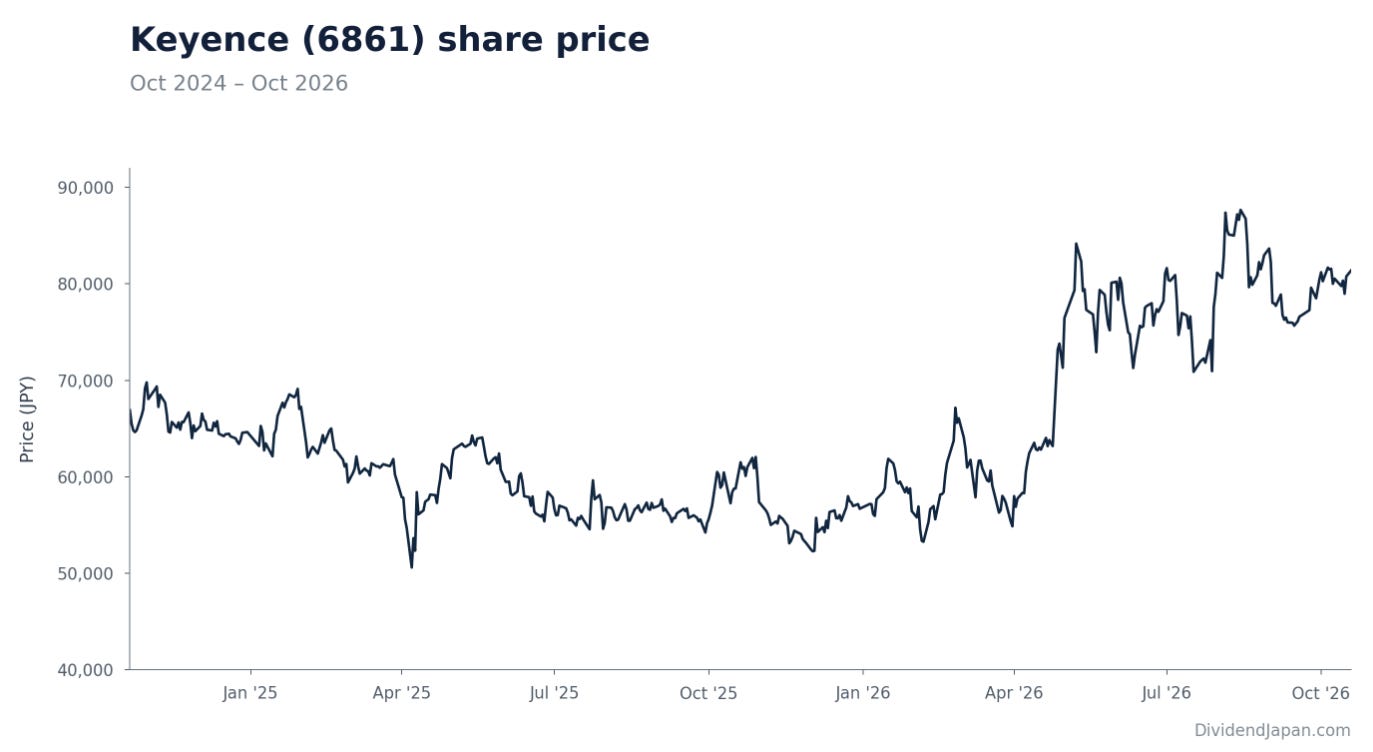
Keyence (TSE: 6861) develops industrial sensors, inspection systems and measurement equipment used to automate manufacturing processes. Lesser known Keyence actually is one of the biggest companies in Japan with a current market cap of $125 billion. The stock is trading near its all time high at 81.410 yen.
FANUC (TSE: 6954) is one of Japan’s major industrial robotics manufacturers, supplying robots and computerized numerical-control systems to customers worldwide.
Yaskawa Electric (TSE: 6506) manufactures industrial robots, servo motors, motion-control systems and related automation equipment.
Another specialist is Harmonic Drive Systems (TSE: 6324), which produces precision reduction gears used in robots and motion-control applications.
These components allow robotic joints and industrial machinery to move accurately and repeatedly.
DividendJapan previously examined both companies in our article about Harmonic Drive, FANUC and the emerging humanoid robotics market.
The relevance of these technologies extends beyond Japanese factories.
Labor shortages are affecting many developed economies, including countries in Europe and North America.
Consequently, Japanese manufacturers of automation equipment can serve both domestic and international markets.
This creates a distinction between Japan’s demographic problems and the commercial outlook of individual Japanese technology suppliers.
Not every automation company will necessarily experience higher profits, but the demand drivers are identifiable: labor availability, production efficiency, operating costs and investment in new manufacturing capacity.
More women, older employees and foreign workers
Automation is only part of the response to population decline.
Japan is also trying to make better use of its existing labor force.
Female employment has increased substantially over the past decade, while more older Japanese residents are remaining economically active beyond traditional retirement ages.
Foreign workers are another increasingly important component of the labor market.
According to the OECD Employment Outlook 2026, the employment rate for Japanese women aged 15–64 reached 75.7% in the first quarter of 2026.
The OECD nevertheless identifies considerable scope for additional improvements, particularly through better childcare arrangements, more flexible employment practices and increased access to regular employment.
Older workers also play an important role.
Extending working lives can help offset the decline in the traditional working-age population, although this requires attention to training, working conditions and productivity.
Meanwhile, immigration and foreign-worker programs can partly ease shortages in sectors such as manufacturing, construction, healthcare and services.
These measures will not completely reverse Japan’s demographic decline. However, they can reduce pressure on the labor market and support economic activity.
Government investment in AI, semiconductors and energy
Japan’s government is also attempting to develop additional sources of economic growth through investment in strategic industries.
Semiconductors and artificial intelligence have become central parts of this strategy.
The Ministry of Economy, Trade and Industry (METI) is supporting new production capacity, computing infrastructure, research and development, and technological innovation.
One example is the government’s GENIAC program, which supports Japanese developers of generative AI models.
In May 2026, METI announced additional support for AI-ready manufacturing data and robotics foundation models.
The ministry explicitly connected these initiatives to Japan’s declining population and structural labor shortages.
Investment is also directed toward advanced semiconductors, quantum technology, economic security and the energy transition.
In its 2026 industrial-policy report, METI emphasized technological competitiveness, international expansion and investment-led growth.
Energy security is another important consideration.
Increasing domestic energy production through renewables, nuclear power and other technologies could gradually reduce Japan’s dependence on imported fossil fuels.
However, these initiatives require substantial capital and their economic effects will develop over time.
Government support alone does not guarantee the commercial success of individual projects or companies.
Why Japanese stocks can grow faster than Japan’s economy
There is one distinction that is particularly important when examining the Tokyo Stock Exchange.
Japan’s economy does not need to grow rapidly for Japanese listed companies to generate substantial revenue and profit growth.
Many of the country’s largest businesses operate globally and derive significant portions of their revenue from customers outside Japan.
Consider several familiar examples.
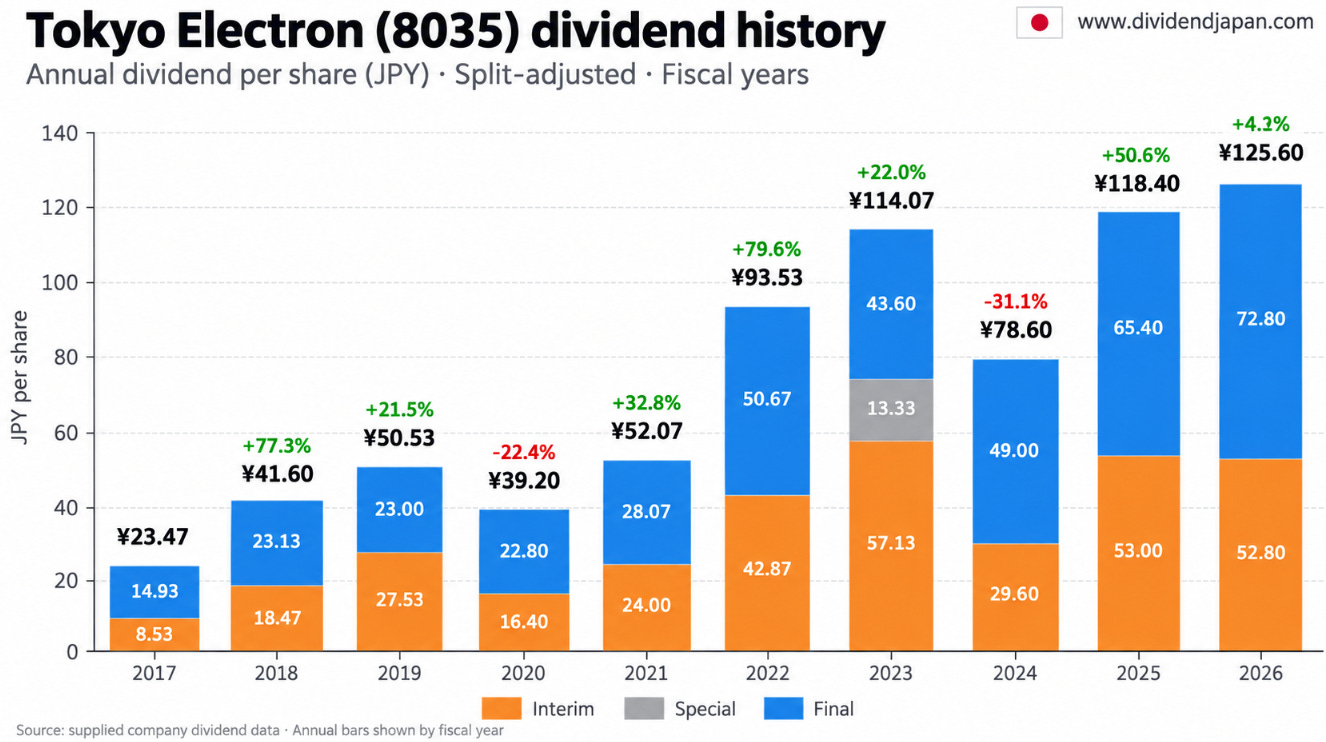
Tokyo Electron (TSE: 8035) manufactures semiconductor production equipment used by chipmakers around the world.
Toyota Motor (TSE: 7203) sells vehicles internationally, while Sony Group (TSE: 6758) operates across entertainment, gaming, image sensors and other global markets.